
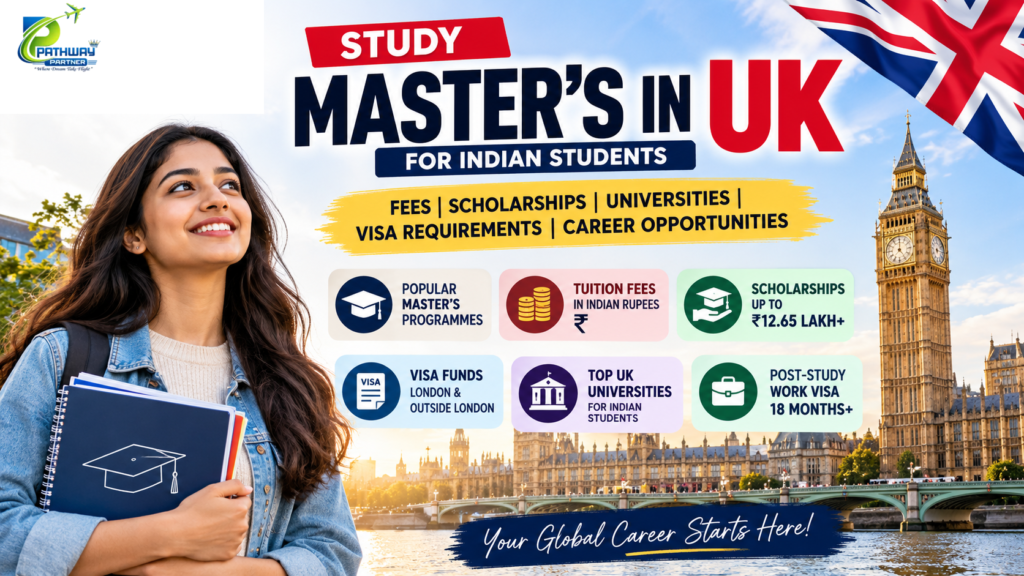
Study Master’s in the UK for Indian Students: Fees, Scholarships, Universities & Visa Requirements
Are you planning to pursue a Master’s degree in the UK? The United Kingdom is a popular destination for Indian students seeking internationally recognised qualifications, quality education and global career opportunities. With many one-year postgraduate programmes, students can gain specialised knowledge while managing their overall study duration.
At Pathway Partners, Chandigarh, we help students explore suitable UK universities and understand admission requirements, tuition fees, scholarships, English-language options and student visa documentation.
Benefits of Studying a Master’s in the UK
1. Internationally Recognised Degree
UK universities offer qualifications recognised by employers and academic institutions worldwide. A Master’s degree can help students strengthen their professional profile and develop specialised knowledge.
2. One-Year Master’s Programmes
Many full-time taught Master’s programmes can be completed in approximately one year, allowing students to complete their postgraduate education in a shorter period than many two-year programmes.
3. Wide Range of Courses
Students can choose from Business Management, Computer Science, Digital Marketing, Finance, Data Analytics, Engineering, Healthcare Management and other specialisations.
4. Practical Learning
UK universities often include assignments, presentations, research projects, case studies and practical learning activities.
5. International Exposure
Students can experience a multicultural environment, develop communication skills and build international connections.
6. Post-Study Work Opportunities
Eligible graduates may apply for the UK Graduate visa after completing an eligible qualification and meeting the relevant immigration requirements.
Popular Master’s Courses in the UK
Indian students can explore the following postgraduate programmes according to their academic background and career goals:
MSc Management
MBA
MSc International Business
MSc Accounting and Finance
MSc Computer Science
MSc Data Science
MSc Cyber Security
MSc Digital Marketing
MSc Business Analytics
MSc Project Management
MSc Supply Chain Management
MSc Human Resource Management
MSc Public Health
MSc Mechanical Engineering
Admission requirements vary by programme. Certain courses may require relevant academic qualifications, professional experience or specific subject knowledge.
UK Master’s Tuition Fees in Indian Rupees
Tuition fees depend on the university, course, location and intake. The following figures are indicative estimates for international students.
| University or programme category | Estimated tuition fees |
|---|---|
| Many universities outside London | ₹19–28 lakh |
| Specialist or higher-cost programmes | ₹25–38 lakh or more |
| London universities and premium programmes | ₹23–44 lakh or more |
These figures are estimates, not fixed university fees. Students should check the exact tuition fee for their chosen course and intake.
Apart from tuition fees, students should budget for accommodation, food, transportation, visa charges, the Immigration Health Surcharge, flights and personal expenses.
Scholarships for Master’s Students in the UK
Scholarships can help reduce the overall cost of studying in the UK. Depending on the university and eligibility criteria, students may receive partial tuition-fee discounts or competitive scholarship awards.
Possible funding options include:
University merit scholarships
International student scholarships
Postgraduate excellence awards
Eligible government-funded scholarship programmes
As an illustrative planning range, scholarships may be worth approximately ₹1.25 lakh to ₹12.65 lakh or more. Actual awards vary by institution, course, academic performance and intake.
Students should check scholarship deadlines, eligibility criteria and whether a separate application is required. Scholarships are not guaranteed.
How Much Money Is Required for a UK Student Visa?
Students generally need to demonstrate sufficient funds for their outstanding tuition fees and living costs under the applicable UK Student visa rules.
The currently published living-cost requirements are:
| Study location | Monthly living funds | Funds for 9 months |
|---|---|---|
| London | ₹1.93 lakh | ₹17.41 lakh |
| Outside London | ₹1.48 lakh | ₹13.33 lakh |
These rupee figures use an illustrative exchange rate of £1 = ₹126.5. Actual currency rates may vary.
In addition to the required living funds, students must account for outstanding tuition fees according to their CAS and the applicable visa rules.
Bank Balance and Financial Documents
Under the standard rules, students generally need to hold the required funds for at least 28 consecutive days, with the end of that period falling within 31 days of the visa application date.
Acceptable evidence may include qualifying bank statements, eligible official sponsorship or an acceptable student loan, subject to the relevant requirements.
Always verify the latest requirements on the official website: https://www.gov.uk/student-visa/money
Studying in London vs Other UK Cities
Studying in London
London offers a large international business environment, extensive public transport, cultural attractions and access to a wide range of employers. However, accommodation and everyday expenses can be higher than in many other UK cities.
The currently published Student visa living-cost requirement for London is approximately ₹17.41 lakh for nine months.
Studying Outside London
Students can explore cities such as Coventry, Birmingham, Leicester, Chester and Wolverhampton. Depending on the location and lifestyle, living expenses may be more affordable than in London.
The currently published Student visa living-cost requirement outside London is approximately ₹13.33 lakh for nine months.
Students should compare tuition fees, accommodation, transport, course quality and career opportunities before choosing a university.
Can Students with an 8–10 Year Study Gap Apply?
Yes, students with a long study gap may be considered for some UK Master’s programmes. However, admission is not guaranteed and depends on the university’s individual requirements.
Universities may consider:
Previous academic qualifications and marks
Relevant work experience
The reason for the study gap
Professional development and career progression
The relationship between previous education and the proposed course
English-language proficiency
Applicants should prepare an honest explanation of their study gap and provide supporting documents when requested.
Is an MOI Letter Accepted in the UK?
A Medium of Instruction (MOI) letter confirms that a previous qualification was taught in English.
Some universities may accept an MOI letter for eligible applicants. Acceptance depends on the university, course, previous institution and other conditions.
An MOI letter is not universally accepted and does not automatically replace IELTS, PTE or other required English-language evidence.
There is no universal rule guaranteeing acceptance of an 8–10 year study gap on an MOI basis. Each application must be assessed individually.
Can You Study in the UK Without IELTS or PTE?
Some universities may accept alternative English-language evidence depending on the applicant’s profile and selected course.
Potential options include:
IELTS Academic
PTE Academic
Other English-language qualifications accepted by the university
MOI letters, where permitted
Alternative university English-language assessments, where available
Some institutions use their own English-language tests, which may be referred to as ELT or another institution-specific name. Students should confirm the exact test and whether it meets university admission and applicable visa requirements.
Do not assume that every university accepts MOI or that IELTS and PTE can always be waived.
UK University Interviews: What Should Students Expect?
Some universities conduct interviews as part of their admission process. Depending on the institution, interviews may take place online or face to face.
Common interview questions include:
Why have you chosen the UK?
Why do you want to study this Master’s programme?
Why did you select this university?
How does the course relate to your previous education or work experience?
What are your future career plans?
How will you finance your studies?
Some interviews are straightforward and focus on understanding the applicant’s intentions. However, interview difficulty varies by university and programme.
Students should prepare honest answers and understand their chosen course, university, financial plan and future goals.
Best UK Universities to Explore for Master’s Programmes
Students from Punjab, Haryana and other Indian states can explore the following universities according to their academic profile, preferred course and budget.
1. University of East London
Offers postgraduate options in business, computing and other subject areas. Students can explore available courses, international tuition fees and English-language requirements.
Website: https://www.uel.ac.uk/
2. University of Hertfordshire
Offers postgraduate programmes in business, computing, engineering and technology.
Website: https://www.herts.ac.uk/
3. Coventry University
Provides postgraduate options in business, engineering, computing and related disciplines.
Website: https://www.coventry.ac.uk/
4. University of Chester
Offers postgraduate programmes across a range of academic areas. Students should check the requirements for their selected course.
Website: https://www.chester.ac.uk/
5. University of Wolverhampton
Provides Master’s programmes in areas including business, computing and engineering.
Website: https://www.wlv.ac.uk/
These universities are options to investigate, not guarantees of admission, IELTS/PTE waivers or MOI acceptance. Entry requirements, scholarship availability and English-language policies can change by course and intake.
Work Opportunities After a UK Master’s
Eligible graduates may be able to apply for the UK Graduate visa after successfully completing an eligible qualification.
According to the currently published rules:
Applications made on or before 31 December 2026 may qualify for a two-year Graduate visa for eligible Bachelor’s and Master’s graduates.
Applications made on or after 1 January 2027 are subject to an 18-month Graduate visa period for most Bachelor’s and Master’s graduates.
Eligible doctoral graduates may qualify for a three-year Graduate visa.
The Graduate visa allows eligible graduates to work or look for work in the UK without employer sponsorship under that route, subject to its conditions. It cannot be extended, although eligible individuals may be able to switch to another immigration route.
A Graduate visa does not guarantee employment, permanent residence or future visa approval.
Official information: https://www.gov.uk/graduate-visa
Who Should Consider a Master’s in the UK?
A UK Master’s degree may be suitable for students who:
Have completed a relevant Bachelor’s degree
Want to specialise in a particular subject
Wish to improve their professional qualifications
Have relevant work experience and want career progression
Can meet admission and English-language requirements
Can prepare the required financial documents
Have researched the course and its career outcomes
Students with long study gaps or unusual academic backgrounds should seek an individual eligibility assessment.
How Pathway Partners Can Help You
Choosing the right course and university is an important step towards studying in the UK.
Pathway Partners can help students explore suitable options and understand the application process according to their individual circumstances.
Our guidance may include:
University and course selection
Academic profile assessment
Study-gap assessment
English-language and MOI eligibility enquiries
Application document preparation
Tuition fee and scholarship information
Student visa documentation guidance
Final admission, scholarship and visa decisions are made by the relevant universities and authorities.
Start Your UK Master’s Journey Today
Planning to study a Master’s in the UK? Contact Pathway Partners to discuss your academic background, preferred course, study gap and budget.
Pathway Partners – Chandigarh
Address: Second Floor, SCO 253, 44C, Sector 44, Chandigarh, 160047
Phone: 97799 51191
Take the next step towards your international education goals with informed course selection and careful financial planning.
Frequently Asked Questions
Can I study a Master’s in the UK with an 8–10 year study gap?
Possibly. Universities assess academic history, the reason for the gap, work experience and course suitability. Admission is not guaranteed.
Can I study in the UK without IELTS?
Some universities accept alternative English-language evidence, including MOI for eligible applicants. Requirements vary by institution and course.
What is the tuition fee for a UK Master’s in Indian rupees?
Many programmes cost approximately ₹19–28 lakh, while some specialist and London-based programmes may cost ₹25–44 lakh or more.
How much money is required for a UK Student visa?
Under the currently published requirements, students need approximately ₹17.41 lakh for nine months of living costs in London or ₹13.33 lakh outside London, in addition to the relevant outstanding tuition fees.
How much scholarship can I get?
Scholarships vary by university and applicant. Some awards are worth several lakh rupees, but eligibility and amounts must be confirmed.
How long can I stay in the UK after a Master’s?
Eligible graduates applying by 31 December 2026 may qualify for a two-year Graduate visa. Applications from 1 January 2027 are subject to an 18-month duration for most Bachelor’s and Master’s graduates.
Are UK university interviews difficult?
Interviews vary by institution and programme. Preparing clear answers about your course choice, academic background, finances and career goals can help.
Currency disclaimer: All rupee amounts are illustrative estimates based on £1 = ₹126.5. Actual exchange rates, tuition fees, scholarships and immigration requirements may change. Verify the latest official information before making financial or immigration decisions.